Translate

Sunday, May 18, 2014

Defend The Hill: Lasalle AAR

After being directed to a post on columns verses lines in Lasalle, I made a suggestion for what I believe was a more constructive approach to dealing with the situation as opposed to some of the suggestions listed on the post. This was not the first time I had run across the issue, as it creeps into all Napoleonic rules to one degree or another. Although I do not recognize this to the level as a problem, I do see an historical point of view that was never addressed for point blank volley fire into deep formations. So, the rule used in this scenario as an experiment is:

An experienced infantry battalion in line, firing into an enemy unit in attack column or waves formation, may double shooting dice if within 2BW.

The latest store battle using Lasalle. This was a six player game with the French having a fair numerical advantage but the Anglo-Portuguese having a better position with concealment, if needed. It was a classic slug fest biding for supremacy of the field. Here we see the Portuguese contingent on the Allied right flank and in the background, the French left wing. The Allies had a numerical advantage on this flank.

I commanded the Allied center, which was to turn out to be the only part of the line that held. I'm certain this was due to the more aggressive nature of the French commanders on the flanks than my commanding.

This is the Allied left flank. Opposing them is an entire division of French dragoons and a brigade of infantry. This was to be the flank that decided the entire battle and would see the fiercest fighting.

Early in the battle the French dragoons were quite impulsive and made some rash charges which largely worked. The British square here manages to push back the dragoons but only for a moment. The French artillery is managing to soften up the defenders along the ridge which will be important later on during combat.

This will be the last image of the Scots Greys in the center. They were subsequently charged and routed off the field in one really decisive combat. Some more exchanges of cannons fire back and forth and little effect for either side.

On the Allied right, the Portuguese units with a Brunswicker battalion mixed in for fun, stand awaiting the rapidly approaching French. The French player on this particular wing seemed to be aggressive in wanting to engage but uncertain as to what formation to use. As it will turn out, multiple units will repeatedly change formation.

Back to the Allied left flank, the front British battalion was unable to pass a discipline test to form a hasty square and was promptly swept from the field. The rear battalion did manage to form square as normal and repulse the dragoons. Attempting to plug the gap, some British light dragoons came from the far left to try and cover the breech from the Scots Greys. The Royal Horse Artillery battery chose to stand its ground and fire into the chargers and take its chances in the melee. Clearly, that was a gamble.

With the artillery slaughtered (no surprise there), the square was a bit isolated and quickly going to be facing multiple cavalry units unless things change. The French artillery on this sector was now silenced due to the inability to have a clear path to any target. From this point on, this flank only managed to turn into a series of melees as the cavalry show no fear of the British battalions who were too spread out to support each other.

On the Allied right flank, the French move the artillery up close and canister the far flanking Cacadore unit. Over a few turns of longshot and canister, it was blown away. The series of melees here should have been in the Allied favor if for no other reason than sheer numbers. Due to the disadvantageous attack column the Allied player chose for a defensive formation, the fire power was reduced. This formation did allow more numbers to be brought to bear on a reduced frontage, however it did not provide and reserve to plug holes. It also could not return fire with as much power.

The French player on this wing was using a tactic used more frequently by the Prussians in 1813-1814. Cavalry come up, force the infantry into square while artillery and infantry take advantage of the situation. Here the Allied commander was facing odds not in his favor and can be excused for not being able to repulse everything thrown at him.

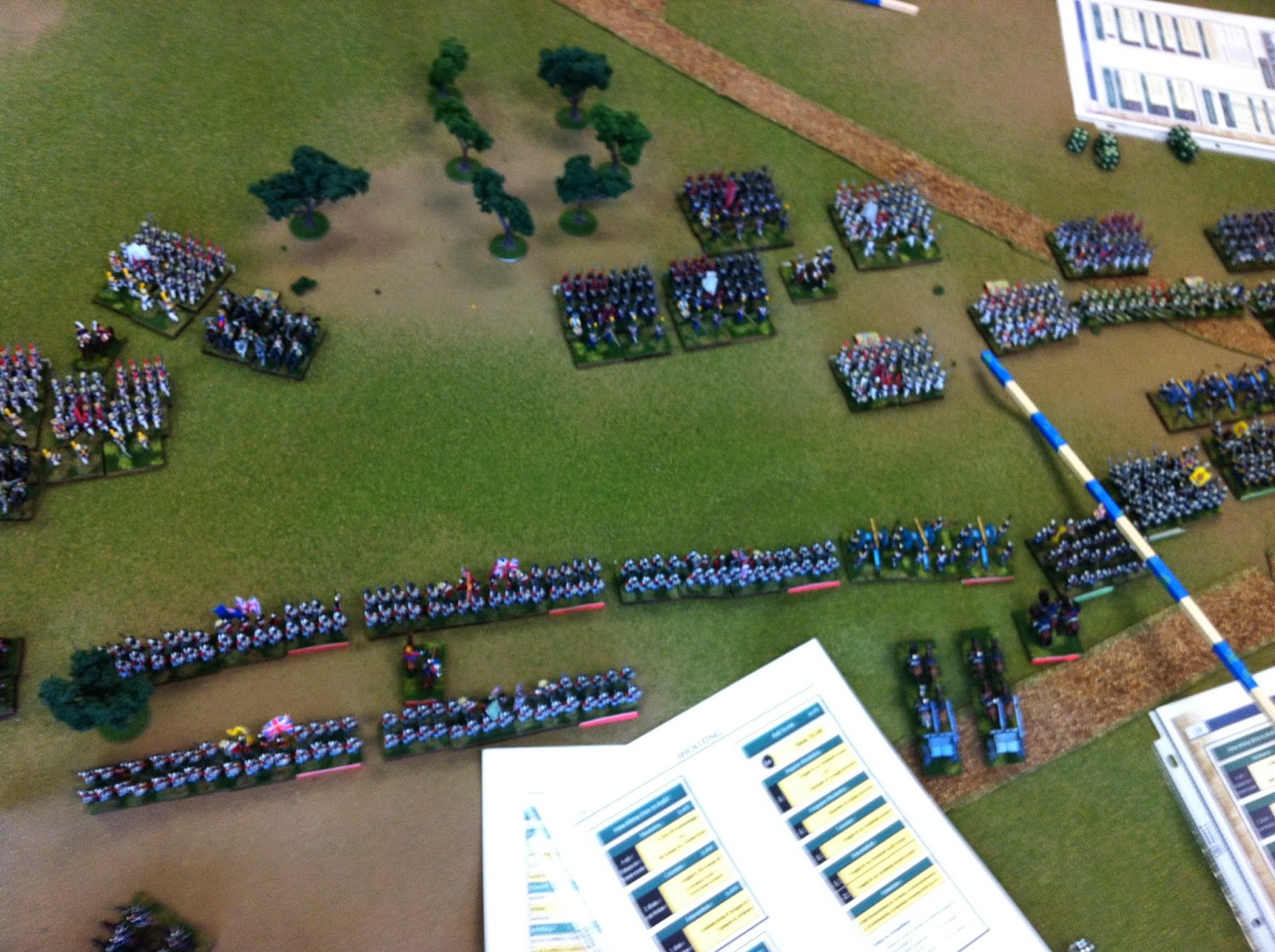
Here we see my opposite moving his forces toward the flank rather than smack dab into the center lines. My artillery played against these columns, but not enough to slow any of the approaching battalions down. Perhaps the Portuguese were seen as the weaker link.

My hussars had been shifted to cover the collapsing Allied left flank and as they arrived, two more British battalions routed. The light dragoons also were beaten off the hill and the great turning movement was made by the French. Both of my hussar units are lining up to charge the victorious French dragoons who moved up too far forward when consolidating their position.

Here in the center, my artillery fired canister until charged. Managing to limber up, they evaded contact with the opposing French battalion and moved to the rear. I then moved them off to try to slow the French tide on my left. My far right battalion (69th Foot) was charged by both the 1er and 2ème battalions of the 4ème Légère. The 69th did some good shooting and only suffered a minor push back from the combat. Here the shooting rule did allow me to easily inflict one casualty on each battalion.

Alas, the Allied right was outflanked to match the other flank. The dead pile on the upper right is quite lopsided when seen to the French dead pile of only one battalion on the upper left of the picture. Even if the break point for the army had not been reached at this point, the Allied player here had clearly a confused defensive strategy. The French may have changed from march column to attack column to line, but the Allied general here couldn't be bothered with dynamic tactics. Not pictured, but on the opposite flank my hussars managed to route the French dragoon unit opposed to it and that act concluded the battle.

In review, the adjusted rule for opposing columns was not as well used here as it could have been. Primarily, the Allied right was never able to exercise it and the center was only able to use it near the end of the battle. Ironically enough, the French managed to use it more effectively against the uninspired Allied right that remained in attack column. This explains why the French here formed into line and did put it to good use. The adjustment is not a game changer by any stretch of the imagination, however it is a bit more formidable than as written currently in the rule book. I believe for the mean time, I will retain it until something changes my mind.

Monday, May 5, 2014

Master Class Painting Review of La Haye Sainte

In the previous post I stated I would do a follow up once I had the La Haye Sainte kit in hand. Literally one week from when Denise at Master Class Terrain Painting received it, I had it back on my door step. This post would have gone up earlier but I was busy with a variety of things.

The package arrived packed well enough. I was asked to follow up with a comparison of a figure for reference in scale. An 18mm AB French sergeant is being used here. As you can see, the scale is just great. As for the painting...

Well who could complain! The coloring is quite realistic and appears to be as if you're looking at the genuine specimen. Since the real building is painted brick, paint does wear thin over time as sun and rain takes its toll.

The wood on the doors and shutters appears as real wood ought to appear. If La Haye Sainte had painted wood, there isn't much documentation to represent it.

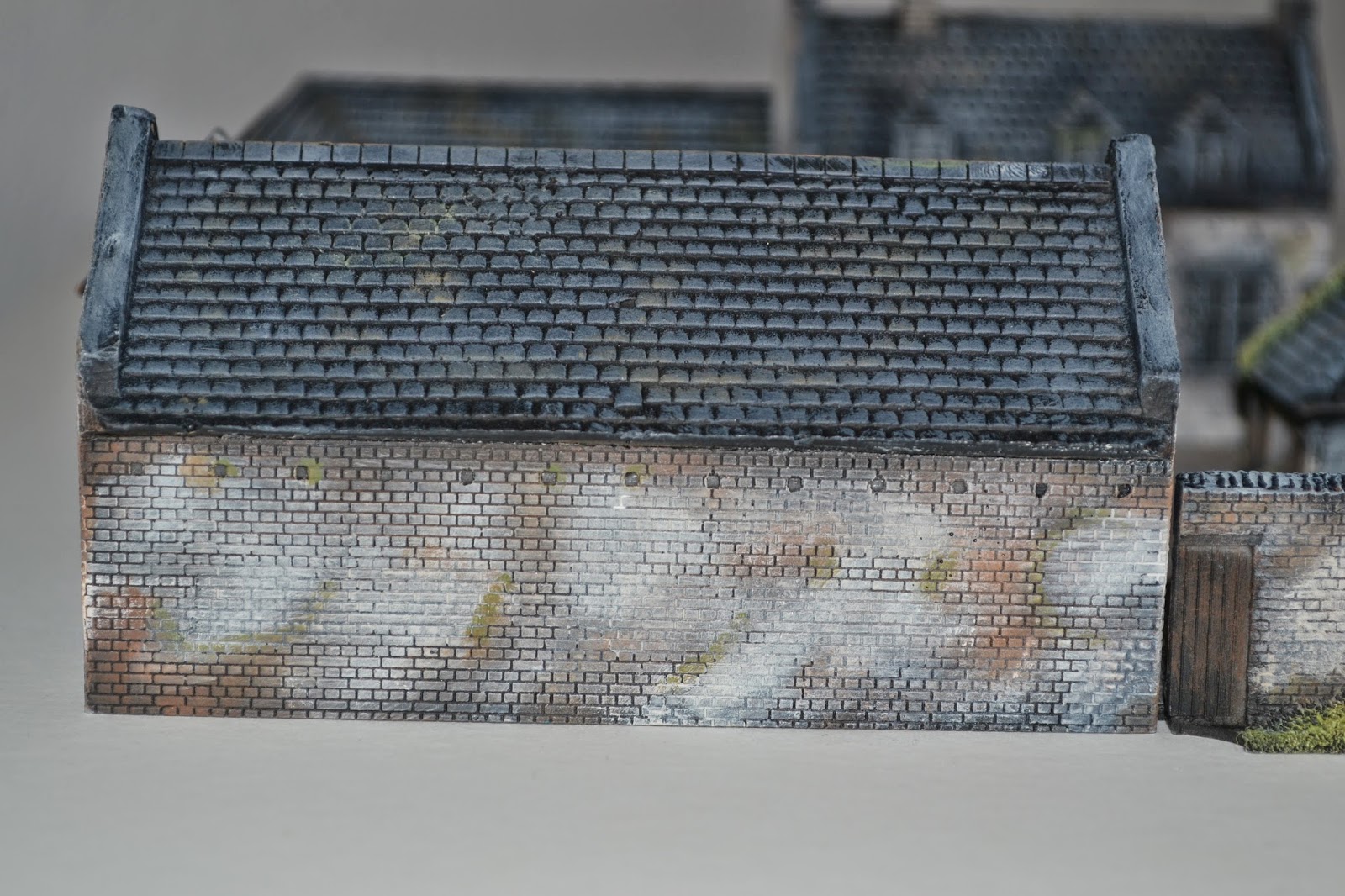
The uneven weathering of the roof is apparent in this image. The uniform, eveness we see today is a result of factory production instead of local shops turning out batches with possible variations.

Here we see the rear of the farm. Again, weathering applied quite well to enforce a realistic appearance. All the small brickwork still evident in the model and the painting. No heavy-handed dry brushing going on here.

Here the side door has stone work around the windows that is picked out with subtle greys. All the various weathering with the green vine gives it a good look. Denise really took time blending colors so as to avoid sharp and harsh transitions that I was hoping to avoid. My instructions weren't too detailed, just weathering being a prime concern. This complex was not new at the time of the battle and I didn't want it to appear like a cartoonish version with overly-bright colors and sharp lines defining transition.


Denise exceeded what I had expected this kit could look like in my mind. She was quick to respond with questions and updates. Some people we deal with in the miniature or painting business display an almost apathetical attitude toward customers, but not so with her. Followers of this blog may recall my other buildings she did as seen here: http://thepeninsularwar.blogspot.com/2011/02/review-sabol-designs-spanish-villages.html

Her skills are truly honed to a rare state of perfection that most modelers hope to achieve at some point in their life. From reviewing her other work on her site: http://www.masterclassterrain.com/, one can see she's not some amateur. If you are considering having some terrain painted up nice so that it will enhance your gaming table and impress your friends, then give her a try. In the future, I will be sending more terrain her way and will keep the blog updated with new terrain as it all happens.

Wednesday, April 23, 2014

La Haye Sainte Review: Tiger Terrain


While browsing eBay, I came across some beautiful and yet unique, resin buildings themed around the 1815 campaign. There were several of these buildings and I had not previously encountered. They were selling quite high likely because since even the owner appeared to be forgetful of what manufacturer created them, people probably assumed it was no longer available. I also made that assumption as I had never seen them before.


The Miniatures Page folks had some difficulty in figuring it out when I made a post that asking for help finding the manufacturer. It turns out to be from the Opus Miniatures line, now under control of Tiger Terrain. The company does not have a web site at the moment, but Stephan was kind enough to send me his catalogs and explain how he had taken over the line and was retooling the molds. The PDF catalog has great images of various buildings, bridges and other terrain that really is high class. In the past, I had purchased the La Haye Sainte kit from JR Miniatures. Although cheaper and crude, it doesn't hold a light to this kit. A plaster kit, as what Jr Miniatures offers, is not a great method of modeling detail. Until recently, I assumed La Haye Sainte was stuccoed.


This kit is resin and no molding lines were present anywhere, nor any flash or releasing agents. It was so clean I almost assumed he cleaned it up for me knowing I was doing a review, but he assured me he does not use releasing agents and the molds are new. Perhaps not evident from the pictures is the individual bricks can be seen and are all clean and precise. I wasn't able to find any blurring of details or sagging pieces. Everything slides together like a tight fitting puzzle.

One thing that attracted me to the model and sealed the deal is that it is suited for the larger 15mm or rather, 18mm ranges. Most manufacturers still insist on the older scales and haven't caught up. The foot print of this kit is indeed a little bit smaller than it ought to be if one were concerned with scale, however many of us do not want urban sprawl on our gaming table. For some reason the picture of the AB French officer on foot didn't come out right on the camera or else it would have been here for a good frame of reference on size.

The model arrived from England quickly and was packaged well. Being a quality resin, all the bubble wrap was unnecessary, but I appreciated the time took to wrap each building and wall section individually.

If you are interested in this kit or browsing their growing range of great buildings and accessories, feel free to contact Stephan at Tiger Terrain via email for your catalog: TigerTerrain@gmail.com


After some careful thought of considering the best way to approach painting this kit, I decided a professional touch might be in order. 32 pounds is nothing to brush off lightly and given the high quality of the buildings I already own (as seen in earlier reviews on my blog), I wanted it top notch. As it may be remembered I had used Sabol Studios for the previous work and it all turned out beautiful. While browsing their work online for other 15mm work they had done, I wasn't able to come across anything new in that scale they did. One thing that did catch my eye was http://www.masterclassterrain.com/ As can be seen from the home page, some of my buildings were present. As they site explains, one of the artists split off. Turns out she (yes, a great female painter! Like a four leaf clover, you hear of them but seldom find one) was the artist who did my other buildings in the past.

I tend to stick with what works and so after some emails back and forth, Denise agreed to take on the commission. This image is only a preview of a review I will do within the next week or so. It is a work in progress and should be done soon but it is already stunning. As can be seen, it is looking quite wonderful with the weathering effects. Her skill is evident and best of all, consistent. She was able to paint Spanish to Belgian and not miss a beat. La Haye Sainte close ups will be given when she's finished and I have in my possession.

Denise is quite the modeler it would seem as viewing her portfolio: http://www.masterclassterrain.com/portfolio-2 She is also working with the renowned Miniature Building Authority in painting their products. Take a look at her work and see if she can't paint some terrain up for you.

Updated picture below:


Monday, March 24, 2014

Twistercon 2014 Lasalle Scenario: Castrejon

I realize I've been very distant from this blog for quite a while but I've been spending much of my time preparing for the convention this past weekend. One of the primary projects during 2013 was painting new AB French to replace my Old Glory units and go with a complete AB French army. All the months were spent on completing several new battalions as well as some cavalry and artillery.


So here are some images of the game I ran with my figures for the Anglo-Portuguese and the French forces.


Castrejon was a skirmish fought between the 4th and Light Divisions who were left more or less as a rearguard by Wellington during the 1812 campaign just right before Salamanca. Finding specifics on French units engaged has eluded me so I had to fill in units present with the Army of Portugal (and a couple of other units I simply liked the uniforms of). I suspect the French did not have many units up and in line, so this scenario was played as if the divergent column was part of the battle.


The battle was fairly slow to get started as the allies decided to slowly push their way forward.


A few turns in, the British artillery tried in vain to cut a path through the French units but failed to do much of anything. The British cavalry and their Portuguese allies were more aggressive and would suffer the brunt of the casualties despite facing almost equal numbers.


The French decided largely to leave the town to the Light Division that came up to occupy it. Multiple attempts would be made by the French 36th Ligne and 2nd Leger without any luck. The French hoped to lure the Light Division into the town and then use the weight of numbers to overwhelm the defenders.


The 3rd Btn of the 36th Ligne and the Cameron Highlanders engaged in a several turn struggle for securing the eastern edge of the town. The Highlanders were unable to recover from the multiple disruptions and were eventually swept away.


As the Anglo-Portuguese force reached its breaking point, much of the Light Division was weakened by failed attacks and two battalions occupying both sectors of the town. By the end of the final turn, the British cavalry was mutilated and the Light Division was facing some surely fatal flank attacks. Allied casualties were double that of the French and beyond the 33% army break point. Wellington will surely be upset at this loss!

May not be shown at the bottom of the pictures, but there were a few units present on both sides. I believe I counted 1450 figures. A nice game of Lasalle that out-shined all the other Napoleonic games going on at the convention.

Monday, November 18, 2013

Flintloque Catalucian Guerilla Cavalry


One of my final units for this force was a guerrilla cavalry unit. One of the nice features in Flintloque is the ability of the Catalucian Guerrillas to alter some of their stats by subtracting from one category and adding to another. The cavalry is a bit limited in this sense in that they have no shooting stats to deduct some points to add to the melee factor. This might seem a bit disadvantageous, but their stats are quite good considering what they're representing.

/>

In my first battle with them, they were the big show stopper. I kept them in reserve for a grand opportunity to pounce on an enemy when they weren't expecting it. Some Ferach line infantry turned a flank to these guerrillas thinking the forest would prevent a charge. Forming into column and then using a melee card for the charge bonus in distance and +3 to the melee factor, the Ferach troops were smacked around thoroughly and tossed back. The Ferach dragoon unit that came up suffered similar results with a minor melee card they were routed and then practically finished off by some artillery as they ran. The guerrilla cavalry's stats are quite similar to the enemies they would commonly encounter. No need to adjust their stats, they're quite good as is.

/>

I decided on a basic brown uniform and catching the eye with a nice yellow that is repeated on the hat, cuffs and trouser stripes along the outer seam. The unicorn was the portion I simply had to reject on the Alternative Armies website. White? Elves on unicorns is hard enough to swallow, but at least dark elves riding dark unicorns isn't so silly. I did them with pure black and heavy highlighting of grey to give it more depth. Considering the alternative, I believe it came out nicely.

/>

Perhaps in spring I'll work on a final line unit and use up some of the spare figures I have on hand. With my son being born a couple of months ago, painting and free time ain't what it used to be. In the next post I'll show off some 15mm AB French I've been painting to replace the Old Glory infantry units.

Sunday, March 24, 2013

Flintloque Catalucians Finished


So after a few months of work, I've gotten through these units and finished up the basing. Seen here are a heavy and medium gun along with limbers. Limbers in this game are not necessary and due to their scale, only have two horses rather than the larger teams that would exist in real life. In any event, such details add to the game.


The line unit, pictured again with the general, but with finished bases. I may raise a second line battalion, however their tactical worth is of little value even if they are cheap point wise.


The first guerrilla unit seen here. In this game, the guerrillas are better than the line units and you can adjust certain stats by taking away from some categories and adding to others. Perhaps a scenario might make you desire to have better shooters than melee troops, then these stats can be adjusted to a degree. Seeing how they are skirmishers, enhancing their shooting abilities would be a wise idea in most cases.


The final unit that will be added in the near future will be a guerrilla cavalry unit when I get around to ordering a couple of more blisters to fill out the unit. Considering how small our games are, I won't need anything more than that to field a complete force for our 1,000-1,500pt games.

Saturday, March 2, 2013

Napoleonic Fantasy: Flintloque


[My daughter reluctantly holds a stand of some guerrillas who she thinks are mad at her because of their mean faces]

For those who may not have known, some wiley Scots with a very unusual sense of humor created a fantasy line centered around the Napoleonic Wars. Their real introduction came around the skirmish version known as Flintloque and then expanded into larger battles called Slaughterloo. The Elves are French and Dark Elves are Spanish, otters are the Ottomans, dogs are the Austrians, ogres are Confederation of the Rhine, undead are Russians, English and Irish are Orcs (most fitting of all), Portuguese as goblins, the Scots are rats and Italians are toads. Leave anyone out?

So many, many years ago as a child, I played a demo game set up at a game shop. Richard Sharpe was there as Richard Sharke and the game was fun, if somewhat hard to take in visually. It doesn't play like fantasy, so other than some odd looking creatures wearing coats with turnbacks and shakos, it plays like a Napoleonic game. I had purchased the Ferach and Toadini (French and Italians in our thinking) and ended up painting them and trading them off several years later.

That friend I traded them to, had added to his collection troops for every one of the nations now. His only hole in his collection was the Catalucian Dark Elves. Having painted many Spanish in 15mm, painting some 28mm ones wasn't much of a stretch. Since they were free to me if I painted them, I've been working on filling out this force and painting it all up.


I went ahead and decided to paint the line troops according to the army book's depiction rather in the later British supplied blue of the 1812 uniforms. The guerrillas didn't have any real uniform but I used a lot of blue as many of the militias were fond of it. Alternative Armies only made one general figure for this line named Don Juan.

I bought a couple of packs to bulk up the guerrilla units as they are better than the line units. The artillerymen, guns & limbers are still on the painting table. Cavalry will be last. I will wait to do all the grass on the stands when everything is painted up. The line units are a maximum of 20 figures, light/guerrilla infantry are 12 figures and the cavalry as 10 figures. The goal is 2 line, two guerrilla units, 2 guns & limbers and 1 guerrilla cavalry unit. I'm about half way there now. I may even be able to get them on the table for a game by spring.

http://www.alternative-armies.com/